
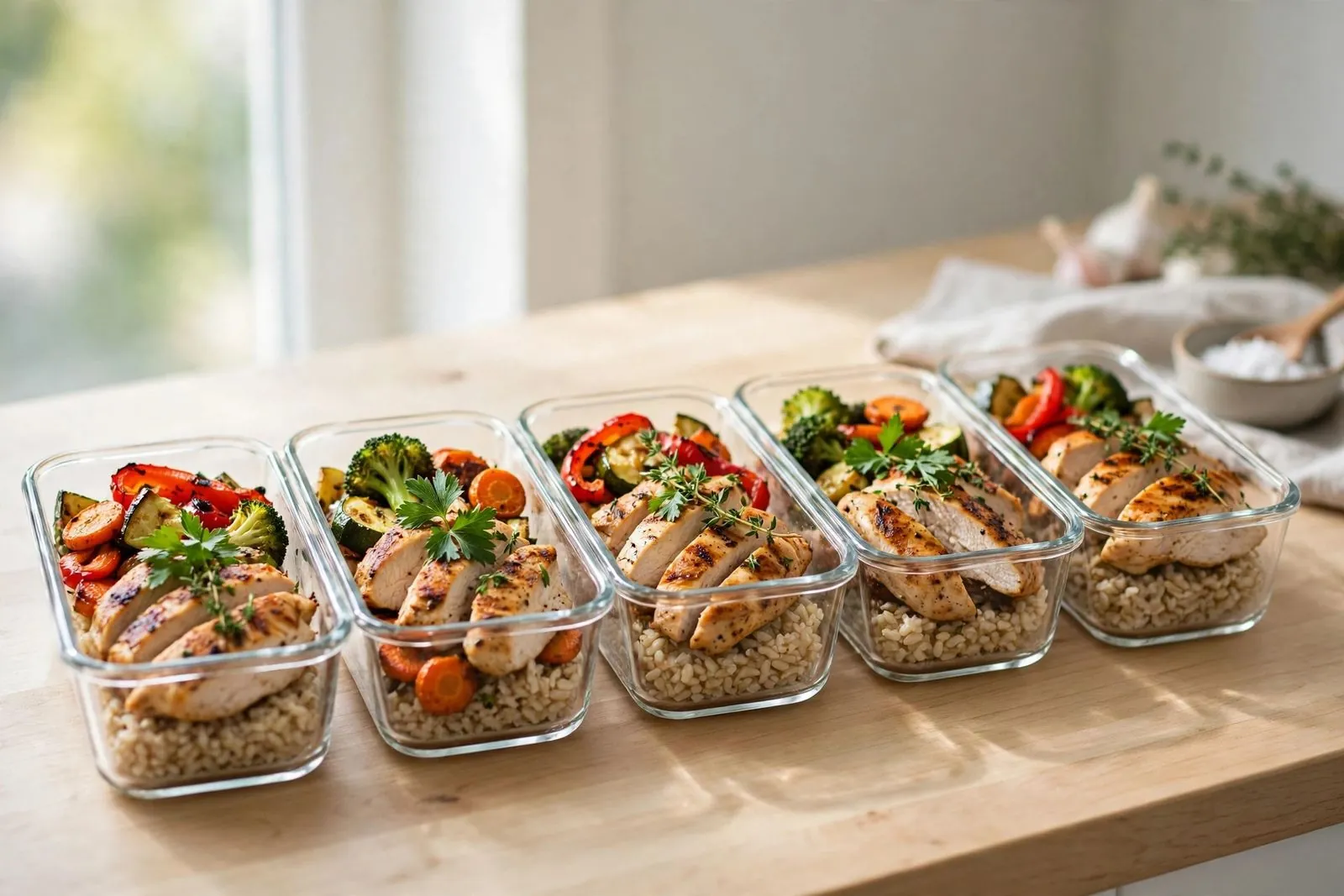
Meal prep means cooking once and eating well for days. One 2-hour session on a Sunday can give you 5 ready lunches for the working week. Cooked food keeps for 3 to 4 days in the fridge, so plan to eat the first boxes early and freeze the rest.
What is meal prep, exactly?
Meal prep is short for meal preparation. You cook several meals in one session, pack them into containers, and eat them over the next few days.
There are two simple styles. Full prep means cooking complete meals, like chicken, rice and vegetables in one box. Ingredient prep means cooking the parts, then mixing them into different meals during the week.
Beginners do best with ingredient prep. It is faster, and the same chicken and rice can become a bowl, a salad or a wrap. You only need one session a week, and about 2 hours of your time.
How do I start meal prepping?
Start small. Prep lunches for 3 days, not the whole week. Three boxes are easier to finish than seven, and you will learn what you enjoy eating twice.
Follow these 5 steps:
- Pick 2 proteins, 1 grain and 3 vegetables.
- Write a short shopping list and buy only what is on it.
- Cook the grain first, then roast the protein and vegetables.
- Cool the food fast, then pack it into containers.
- Label each box with the date and put it in the fridge.
You need very little gear. Four or five airtight containers, a baking tray, a large pot and a sharp knife are enough. Glass containers work well because they go from fridge to microwave without stains or smells.
Set your weekly plan before you shop. NutriPath's AI meal planner can build one for you, or you can write it on paper. Either way, a plan stops you buying food you will not use.
What should go in each box?
A good box has 4 parts: a base, a protein, vegetables and a small amount of sauce. The base is a grain like rice, quinoa or pasta. The protein can be chicken, fish, eggs, tofu, beans or lentils. Fill half the box with vegetables if you can.
Protein is what keeps a lunch filling. An NHS protein guide lists about 32 g of protein in 100 g (3.5 oz) of grilled skinless chicken breast, 25 g in a small drained tin of tuna, and 8 g in one large egg. One box can cover a large part of your day. Our guide to how much protein you need explains your daily target.
Keep sauces separate. A dressing of 60 ml (2 fl oz) in a small pot stops the food going soggy. Salt, herbs and spices cost little and change the flavour of a plain box.
Check your portion sizes once. Our free macro calculator works out your daily protein, carbohydrate and fat targets from your weight and activity. Then weigh one box on your first prep day and use the same amounts each week.
How long does meal prep last in the fridge?
Cooked food keeps for 3 to 4 days in a fridge set at 4°C (40°F) or below. This is the rule from the USDA, and the Mayo Clinic gives the same figure. After 4 days, bacteria can grow even if the food still looks and smells fine.
That 4-day limit shapes your whole week. Cook on Sunday and eat the boxes by Wednesday. For Thursday and Friday, use food from the freezer, or prep a second small batch on Wednesday evening.
- Chill within 2 hours. Put cooked food in the fridge within 2 hours, or within 1 hour if the room is above 32°C (90°F). Bacteria grow fastest between 4°C and 60°C (40°F and 140°F).
- Cool it fast. Divide large batches into shallow containers. Hot food can go straight into the fridge, so do not leave it on the counter to cool.
- Freeze what you will not eat in time. Frozen leftovers stay safe for a long time, and taste best within 3 to 4 months. Thaw them in the fridge overnight.
- Reheat until piping hot. Heat leftovers to 74°C (165°F) all the way through, and stir as they heat. Bring soups and sauces to a rolling boil.
What does a simple week of meal prep look like?

One batch of a few ingredients makes 5 different lunches. Here is a plan that takes about 2 hours on a Sunday.
| Day | Lunch | How it is made |
|---|---|---|
| Mon | Chicken and rice bowl | Chicken, rice, roasted broccoli |
| Tue | Chicken salad | Same chicken, salad leaves, cucumber, 60 ml (2 fl oz) dressing |
| Wed | Chicken wrap | Same chicken, wholemeal wrap, peppers, yoghurt sauce |
| Thu | Lentil and rice bowl (from freezer) | Lentils, rice, roasted carrots |
| Fri | Lentil soup (from freezer) | Lentils, tomatoes, carrots, bread |
Cook 500 g (about 18 oz) of chicken, 300 g (about 11 oz) of dry rice, a pot of lentils and a tray of vegetables on Sunday. Pack Monday to Wednesday in the fridge. Put Thursday and Friday in the freezer on Sunday, then move each one to the fridge the night before.
This plan costs less than buying lunch each day, and you know exactly what is in each box. If you want to know how much to eat in a day, our free calorie calculator gives you a daily target to work from.
What mistakes should beginners avoid?
- Cooking too much. Seven days of the same meal gets boring by Tuesday, and food past its 4th day should be thrown away. Start with 3 days and build up.
- Skipping the labels. Write the date on every box. Without a date, you will guess, and guessing is how old food gets eaten.
- Reheating everything. Only reheat the portion you plan to eat. Keep the rest cold until you need it.
- Dressing salads early. Dressing added on Sunday means a soggy lunch on Tuesday. Small pots keep food fresh.
- Forgetting breakfast and snacks. Overnight oats take 5 minutes the night before, and a bag of cut vegetables with hummus covers the afternoon.
Who should be careful with meal prep?
Meal prep suits most healthy adults, but some people should take extra care. If you are pregnant, under 18, take diabetes medication, have a medical condition or a history of an eating disorder, ask your doctor or a dietitian before changing how you eat.
Food safety matters more for some groups. Young children, older adults and people with a weak immune system get food poisoning more easily. If you cook for them, follow the 3 to 4 day fridge rule strictly and reheat food to 74°C (165°F) every time.
Meal prep is not a diet, and it will not fix your health on its own. It is a habit that makes healthy food easy to reach. Start this Sunday: pick 2 proteins, 1 grain and 3 vegetables, and cook 3 lunches.
This guide is general information for healthy adults. If a plan leaves you hungry or tired, eat more and speak to a dietitian. Never eat under 1,200 calories a day (women) or 1,500 (men) without medical supervision. If you are pregnant, ask your doctor or midwife which foods to avoid and how to store food safely.


